


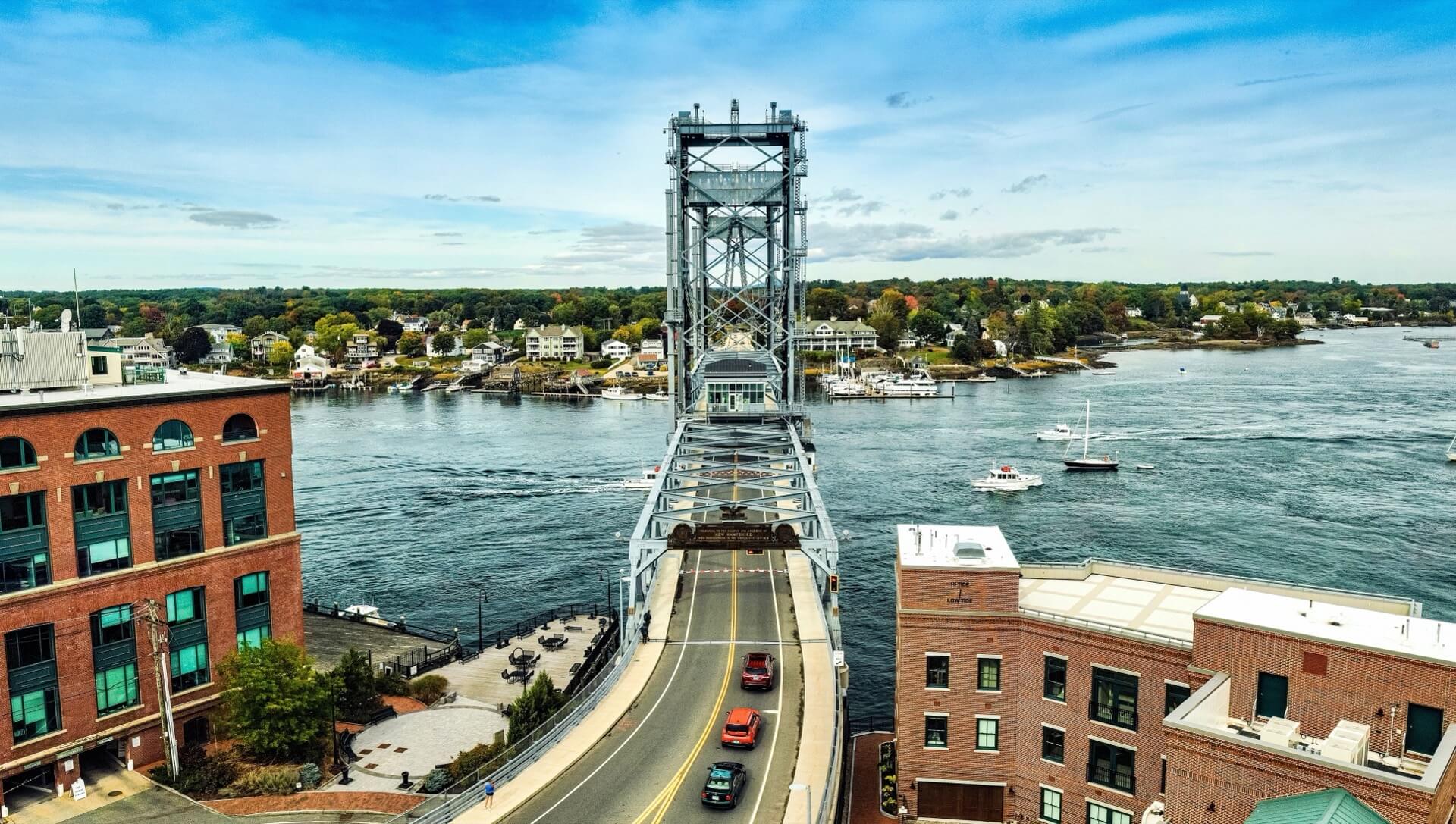


The biggest thing that changed on the New Hampshire Seacoast this year was not the price of a house. It was the rules about what you are allowed to build one on, and a tax structure that works backwards from how most people assume it works.
If you are shopping Portsmouth, Dover, Rye or Kittery right now, you are probably watching the median price tick along and feeling like nothing much is happening. The things that actually moved this year do not show up in that number at all.
Dover's tax rate is more than double Rye's
Everybody assumes the fancy town has the brutal tax rate. You look at Rye, oceanfront, big houses, and you think those people must be getting slaughtered in taxes.
They are not. Here are the 2025 rates:
- Newington: $7.88 per $1,000 of assessed value
- Rye: $8.37 per $1,000
- Dover: $19.68 per $1,000
Source: New Hampshire Department of Revenue Administration, 2025 municipal tax rates.
So the towns with the most expensive real estate on the Seacoast have the cheapest rates, and the towns most people can actually afford carry rates more than double that. Same commute. Same coastline.
The mechanism is not complicated. A town with a large assessed base can fund itself at a low rate. Newington has commercial and industrial property carrying an enormous share of the load. Rye has high home values doing the same job. Dover has neither on that scale, so the rate has to do the work instead.
One thing worth saying plainly, because it cuts the other way: a low rate on an expensive house is still a real bill. A cheap rate and a cheap town are two different things, and the second one is what most people are actually shopping for.
Why the affordable towns carry the higher rate
This is the piece almost nobody connects, and it is not really about your town at all.
In July 2025 the New Hampshire Supreme Court upheld a finding that the state has been funding public schools at about $4,182 per pupil when the constitutional floor is $7,356. That is a gap of roughly $3,174 per student that somebody has to cover.
Source: ConVal School District v. State of New Hampshire, New Hampshire Supreme Court, 1 July 2025.
About seven weeks later, a superior court judge said plainly what everyone in a high-rate town already suspected: local property taxpayers have been covering that gap.
That is not your town being greedy. That is your town paying the state's bill.
What power actually costs here
The other cost that does not show up in anyone's budget until it is already happening is electricity, and the baseline was high before any of this year's increases.
In 2024, residential electricity averaged 24.29 cents per kilowatt hour in Maine and 23.40 cents in New Hampshire, against a national average of 16.48 cents. New Hampshire runs about 42% above the rest of the country.
Source: U.S. Energy Information Administration, Electric Power Annual, Table 4, 2024.
If you are moving here from somewhere nearer that national number, build the difference into what you think the house costs you every month. It is not a rounding error over a year.
Both states just made it harder for a town to say no
For about forty years, housing in New Hampshire worked in a simple way. A developer came to town, the town said no, and that was the end of it.
That is over. New Hampshire now requires towns to allow housing in commercially zoned areas by right, which means no conditional use permit and no hearing where forty neighbors fill the school gym. A separate law requires every town that allows single-family homes to allow one accessory dwelling unit as a matter of right, detached included.
Maine is moving the same direction on roughly a twelve-month delay, with one deadline for everybody: July 1, 2027. Every municipality in the state has to have its land use ordinances amended by then. Kittery, York, Eliot and South Berwick are all working to the same date.
Kittery has also drawn a hard line on the water, amending its floodplain ordinance to create coastal hazard zones where new construction is not permitted at all. If you are looking at an older cottage close to the water there with a tear-down-and-rebuild in mind, that just became a real question rather than a formality. Call the town and confirm where the specific parcel sits before you make a decision on it.
What this means if you are buying here
I will give you the honest caveat. Laws take years to show up on a streetscape. None of this puts an apartment building on Route 1 this spring.
What it changes is what is legally possible, and possible eventually becomes built.
So if you are buying on the Seacoast in the next year or two, the question I would be asking is not only what the house is worth today. It is what is legally allowed to happen next door, and on your own lot. And when you compare two towns, compare the rate and the assessed value together, because one without the other tells you almost nothing.
The full breakdown, with all five changes, is here:
If you are weighing one Seacoast town against another and want to know what any of this means for that specific town, get in touch and tell me which ones you are looking at. And if you are earlier in the process than that, the free Maine and New Hampshire relocation guide is a good place to start.
Check out this article next